
For decades, Parkinson’s disease research has advanced through careful observation, clinical trials, laboratory science, and the dedication of researchers and people living with the disease. While those traditional approaches remain essential, a powerful new tool has entered the picture: artificial intelligence (AI).
AI is often associated with chatbots or image generators, but its greatest impact may come from something far less visible. AI excels at recognizing patterns hidden within enormous amounts of information—patterns that would be nearly impossible for humans to detect on their own. In medicine, this ability has the potential to dramatically accelerate research, improve treatments, and perhaps one day help scientists discover a cure for Parkinson’s disease.
Although AI will not solve Parkinson’s overnight, it is already changing how researchers study the disease. Instead of asking one question at a time, scientists can now analyze millions of data points simultaneously, uncovering relationships that may have taken decades to find using traditional methods.
The result is an exciting new era in Parkinson’s research—one built on data, collaboration, and intelligent analysis.
Parkinson’s Is More Complex Than We Once Thought
One reason Parkinson’s has been so difficult to cure is that it isn’t a single disease.
Two people may receive the same diagnosis yet experience completely different symptoms. One person may struggle primarily with tremor, while another deals mostly with stiffness, balance problems, sleep disorders, or cognitive changes. Even medications can affect individuals in dramatically different ways.
Researchers now believe Parkinson’s likely represents multiple biological subtypes rather than one uniform condition.
Finding these subtypes requires analyzing enormous collections of information, including:
- Genetics
- Brain imaging
- Blood biomarkers
- Medication responses
- Movement patterns
- Voice recordings
- Sleep quality
- Daily symptom reports
- Environmental exposures
- Lifestyle factors
This is exactly the type of problem AI is designed to solve.
Finding Hidden Patterns Humans Can’t See
Imagine trying to assemble a puzzle with ten million pieces.
A human researcher might carefully study one section at a time, but an AI system can compare every piece with every other piece simultaneously.
That’s the power of pattern recognition.
Machine learning algorithms can discover relationships between symptoms that researchers never suspected were connected. They may identify groups of patients who progress more slowly, respond better to certain medications, or share subtle biological similarities.
These discoveries matter because treatments that fail in one group of patients might work remarkably well in another.
Instead of treating Parkinson’s as one disease, AI may help researchers divide it into smaller, more precise categories.
That could eventually lead to truly personalized therapies.
Accelerating Drug Discovery
Developing a new medication has traditionally been a slow, expensive process.
Researchers may test thousands—or even millions—of chemical compounds before finding one worth studying further. Many promising drugs ultimately fail during clinical trials after years of research and billions of dollars in investment.
AI is beginning to change this process.
Instead of randomly screening huge libraries of molecules, AI models can predict which compounds are most likely to interact with specific proteins involved in Parkinson’s disease.
These systems can rapidly answer questions such as:
- Which molecules might protect dopamine-producing neurons?
- Which compounds cross the blood-brain barrier?
- Which drugs are likely to have fewer side effects?
- Which existing medications might unexpectedly help Parkinson’s?
Rather than replacing laboratory research, AI helps scientists prioritize the most promising candidates first.
That means fewer dead ends and more time spent testing ideas with genuine potential.
Discovering New Drug Targets
Before researchers can create a treatment, they first need to understand exactly what they are trying to change.
In Parkinson’s disease, scientists study proteins, genes, cellular pathways, inflammation, mitochondrial function, and many other biological processes.
The challenge is understanding how these systems interact.
AI can analyze enormous biological databases to identify proteins that appear to play critical roles in disease progression.
Sometimes these discoveries reveal entirely new drug targets—proteins or pathways that researchers had not previously considered.
Instead of asking:
“Can we make a better version of today’s medications?”
Researchers can ask:
“What if we’re treating the wrong biological process altogether?”
That shift in thinking may open doors to therapies designed to slow—or even stop—the disease itself rather than simply managing symptoms.
Repurposing Existing Medications
Creating a brand-new drug often takes more than a decade.
Repurposing an existing medication can be much faster.
AI can compare the biological effects of thousands of approved medications against the molecular signatures associated with Parkinson’s disease.
Occasionally, unexpected matches appear.
A medication originally developed for another condition may influence inflammation, protein aggregation, or cellular repair mechanisms that are also important in Parkinson’s.
Because these drugs have already undergone safety testing, researchers may be able to move into clinical trials more quickly.
Several current Parkinson’s studies began after computers identified surprising biological similarities that human researchers had overlooked.
Making Clinical Trials Smarter
Clinical trials are essential for developing new therapies, but they are also incredibly challenging.
Participants often progress at different rates.
Symptoms fluctuate from day to day.
Medication timing affects performance.
These variables make it difficult to determine whether a treatment is truly working.
AI can help by analyzing continuous streams of patient data instead of relying only on occasional clinic visits.
Rather than measuring symptoms every few months, researchers can study how patients function every day.
This provides a much richer picture of disease progression and treatment response.
AI can also help identify participants who are most likely to benefit from specific therapies, making clinical trials more efficient and potentially reducing the number of participants needed.
The Importance of Real-World Data
Historically, neurologists evaluated Parkinson’s during office appointments lasting perhaps 20 or 30 minutes.
But Parkinson’s doesn’t happen only during clinic visits.
Symptoms change throughout the day.
People experience “on” periods when medications work well and “off” periods when symptoms return.
Stress, sleep, exercise, meals, and countless other factors influence daily functioning.
AI becomes much more powerful when it can analyze information collected between appointments.
This includes:
- Walking speed
- Tremor frequency
- Finger tapping performance
- Speech characteristics
- Sleep quality
- Medication timing
- Balance
- Exercise habits
- Mood changes
- Cognitive exercises
When thousands—or eventually millions—of people contribute this information, researchers gain an unprecedented view of how Parkinson’s behaves in everyday life.
Software That Helps Track Symptoms
One of AI’s greatest strengths is learning from consistent, long-term observations.
Software that allows individuals to record symptoms over weeks, months, or years creates valuable datasets that can reveal trends impossible to notice during routine medical appointments.
For example, someone might discover that fatigue consistently increases before medication begins wearing off, or that poor sleep predicts more severe tremor the following day.
Across thousands of users, AI may uncover patterns that no individual could recognize alone.
Researchers could learn:
- Which symptoms typically appear first
- Which combinations predict faster progression
- Which lifestyle habits are associated with better outcomes
- Which medication schedules produce the most stable symptom control
This type of digital tracking also empowers patients by helping them better understand their own disease.
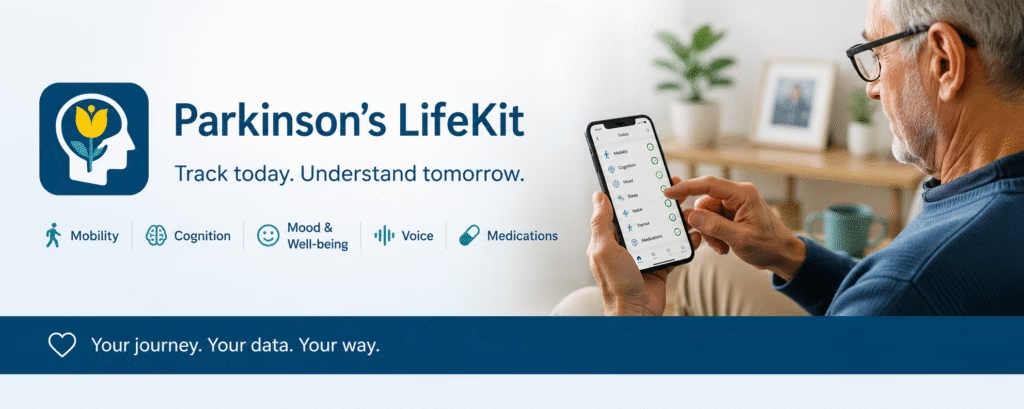
Many people already use tracking tools—including apps such as Parkinson’s LifeKit—to organize symptom observations, medication schedules, and daily experiences. As these datasets grow over time, they may become increasingly valuable not only for individuals and their healthcare teams, but also for researchers seeking broader insights into Parkinson’s disease.
Voice Analysis May Reveal Early Changes
Researchers have long known that Parkinson’s affects speech.
Sometimes these changes occur years before diagnosis.
AI can analyze subtle characteristics of speech that humans cannot easily hear.
These include tiny variations in:
- Volume
- Pitch
- Rhythm
- Pronunciation
- Breathing
- Vocal stability
Over time, voice analysis may help physicians monitor disease progression more objectively than subjective rating scales alone.
It may also identify treatment responses much earlier.
Even short speech recordings collected regularly could eventually become important biomarkers.
Movement Analysis Beyond the Clinic
Modern sensors can capture incredibly detailed information about movement.
Walking.
Finger tapping.
Balance.
Turning.
Handwriting.
Facial expressions.
AI can analyze these measurements frame by frame, identifying microscopic changes invisible to the human eye.
Researchers are exploring whether these digital movement markers can detect progression earlier than traditional neurological examinations.
If successful, doctors may someday measure disease progression with far greater precision than is currently possible.
Predicting Disease Progression
One of the biggest unanswered questions after diagnosis is:
“What will happen next?”
Unfortunately, every person’s journey is different.
AI models may eventually estimate future progression based on hundreds of factors rather than a handful of clinical observations.
These predictions could help physicians:
- Choose treatments earlier
- Plan rehabilitation
- Recommend lifestyle changes
- Identify candidates for clinical trials
- Monitor patients more closely when needed
Importantly, these predictions would guide care—not determine anyone’s future.
Human physicians will always interpret AI recommendations within the broader context of each person’s life.
Combining Information Across Many Sources
Perhaps AI’s greatest advantage is its ability to combine information from completely different fields.
Imagine one system analyzing:
- Genetic information
- Brain scans
- Blood tests
- Voice recordings
- Walking patterns
- Medication history
- Environmental exposures
- Daily symptom logs
- Sleep data
Separately, each dataset tells only part of the story.
Together, they may reveal entirely new biological pathways that contribute to Parkinson’s.
These integrated analyses were simply impossible only a few years ago.
AI Will Not Replace Neurologists
Some people worry that AI will eventually replace physicians.
That is highly unlikely.
Parkinson’s is deeply personal.
It involves emotions, uncertainty, family relationships, values, and quality of life.
Computers cannot replace compassionate conversations or the experience of an expert clinician.
Instead, AI serves as another tool.
It can organize information.
Highlight trends.
Suggest possibilities.
Identify patterns.
But people—not algorithms—will continue making the important decisions.
The future of Parkinson’s care will almost certainly combine human expertise with intelligent technology.
Challenges Still Remain
While AI offers tremendous promise, there are important limitations.
AI systems are only as good as the data they receive.
If the information is incomplete or biased, predictions may also be flawed.
Researchers must also ensure that patient privacy remains protected while allowing scientific collaboration.
Another challenge is diversity.
AI performs best when trained on information representing people from many different backgrounds, ages, ethnicities, and disease stages.
Ensuring broad participation will help future discoveries benefit everyone living with Parkinson’s.
Finally, AI generates hypotheses—it does not prove them.
Every promising discovery must still undergo careful laboratory testing and rigorous clinical trials before becoming accepted medical practice.
A Future Worth Watching
Only a generation ago, researchers had to analyze much of their data manually.
Today, AI can process millions of records in hours.
Tomorrow, it may identify disease mechanisms that have remained hidden for decades.
Will AI discover a cure for Parkinson’s?
No one knows.
But it is becoming increasingly clear that AI will play an important role in helping researchers ask better questions, recognize subtle biological patterns, accelerate drug discovery, improve clinical trials, and better understand how Parkinson’s affects people in everyday life.
Progress in medicine rarely comes from a single breakthrough. More often, it comes from many small discoveries that gradually build toward something transformative. Artificial intelligence has the potential to accelerate each of those steps, shortening the path from observation to understanding, and from understanding to better treatments.
For the millions of people living with Parkinson’s—and the families who support them—that is reason for cautious optimism. The combination of dedicated scientists, advancing technology, and the willingness of patients to contribute their experiences through research and symptom tracking is creating opportunities that simply did not exist a decade ago.
There is still much work to be done. But for the first time, researchers have tools capable of seeing connections hidden within vast amounts of data. Those hidden connections may hold some of the answers the Parkinson’s community has been seeking for years.
And while no one can predict exactly when the next breakthrough will come, AI is helping ensure that the search moves faster, becomes more precise, and brings us closer than ever to understanding—and ultimately overcoming—Parkinson’s disease.